
Places · Street note
Home battery installation in Belfast
Updated
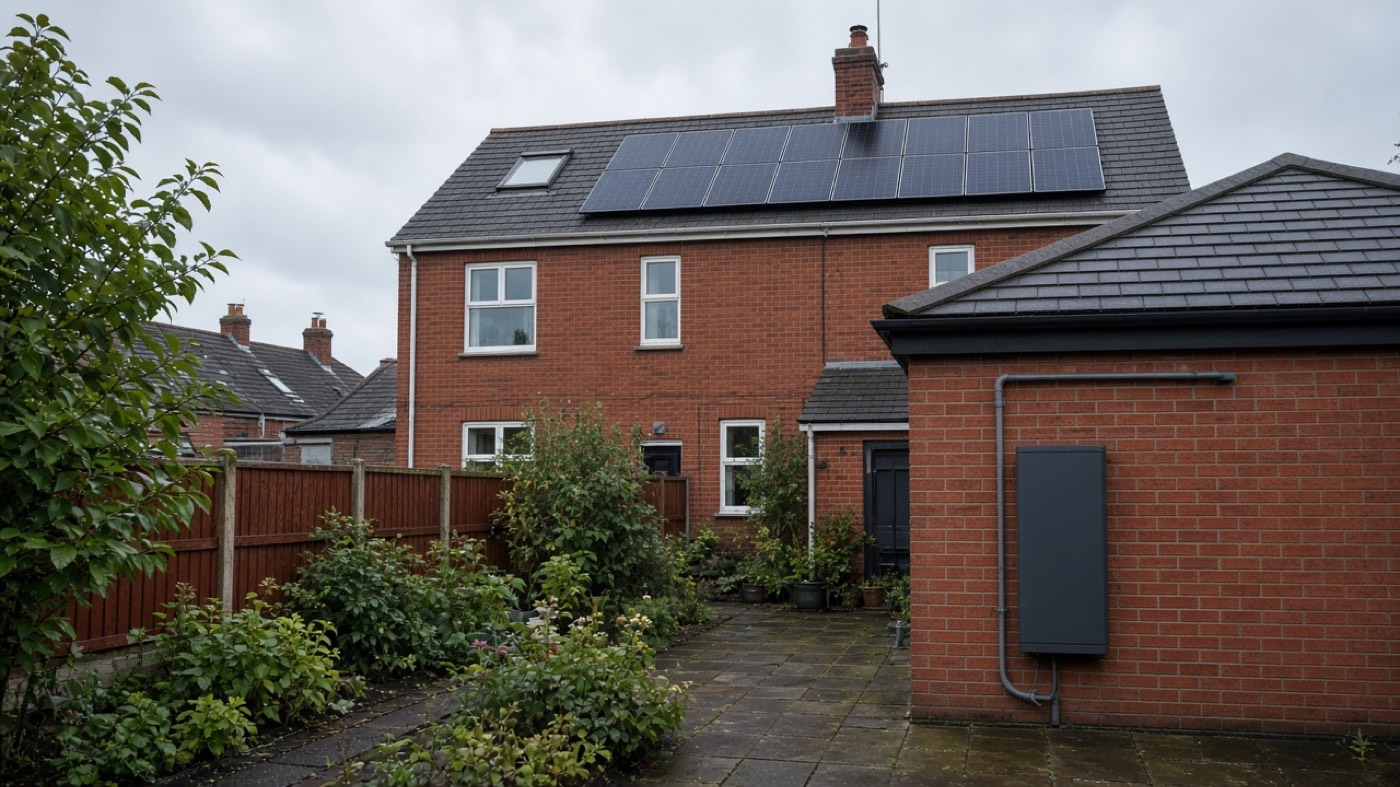
Belfast terraces, semis and apartments follow their own building and electricity rules. NIE Networks is the distribution company, not a GB DNO, and GB connection forms do not travel unchanged across the Irish Sea.
The houses, not the postcode average
Suburban houses can take solar. Terraces and apartments need the same shade, consent and fire-position checks as anywhere else.
Many GB installers do not carry crews or accreditation for Northern Ireland. A UK website claim is not proof of a Belfast installation team.
Terraced streets need a carry plan. Do not import a London parking assumption either.
What gets fitted here
A viable job is a local accredited installer, a house with a safe battery position, and a tariff available on the NI supply market, which is not identical to the GB smart-tariff menu.
Winter solar is limited. Model savings against NI tariffs, not a GB overnight headline.
NIE Networks, yield and a 4 kWp example
A 4 kWp array at 870 kWh per installed kilowatt is about 3,480 kWh a year before shade. That is the local ceiling on solar charging, not a promise the battery will cycle fully in January.
In Belfast, on NIE Networks, 3.6 kW is in the band where G98 connect-and-notify is often enough. Export can still be capped. Agree that before the inverter is ordered. The figure uses 10 kWh and 4 kWp, which is enough to tell two quotes apart if they assumed something else.
Take a 10 kWh pack, cycled about 340 times, at 90% round trip. Charge at 11.0p, and value what comes back at 30.8p. Export given up is priced at 12.0p. About 1943 kWh a year of the charge is treated as spare solar from 4 kWp that might otherwise have been exported. Delivered energy is about 3060 kWh. After charging cost and lost export, the figure saves about £596 a year. Set that against £7,018 fitted, which is a September 2026 illustration at the temporary 0% residential rate, not a quote. That is a simple payback of about 11.8 years on these assumptions. Nudge the night rate up by 4p and see if you still like it.
What I would not sign in Belfast
Where the job is a qualifying install in a home, the 0% rate runs to 31 March 2027 and is due to become 5% after that. This figure prices the work at £7,018 on that basis. It does not apply to a shop, and it does not apply to a battery you buy and fit yourself.
I would not treat backup as included on a 10 kWh quote unless the circuits are listed.
NIE Networks and NI tariffs are not a GB form with a different town name. Many GB crews do not cross the water.
Common questions
Is the price on this page a quote?
No. £7,018 is a September 2026 illustration for a 10 kWh example at the temporary 0% residential rate. Your survey replaces it.
Will it stay on in a power cut?
Only if a gateway or essential-load board was designed and paid for. A standard grid-tied battery turns off with the grid. On this 10 kWh example the inverter is 3.6 kW, and backup is still a separate line.
What paperwork should I keep?
Keep the MCS certificate where the job is certified, the electrical certificate, the DNO record, the schematic, the warranty registration and a photo of the schedule. For an illustrated £7,018 job, that folder is part of what you bought.
What if the cheap rate is not 7p?
Then the figure changes. This page used 11.0p as a charge rate and 30.8p as the rate avoided. A smaller gap means a worse payback. Read the live tariff.
Sources
Want a price for your house?
The figures above are a rough guide. An installer still needs to see your fuse board, where the battery will go, and whether you want power during a blackout.